White or light-colored patches on the skin can be confusing and, for many people, worrying. Is it vitiligo? A fungal infection? Eczema? Or something else entirely? Because several skin conditions can look similar at a glance, self-diagnosing from the internet often leads to the wrong conclusion — and sometimes the wrong treatment altogether. Getting an accurate diagnosis early is exactly why so many people searching for the best vitiligo treatment in Malappuram start with a proper dermatological evaluation rather than guesswork.
At Neoskin Speciality Centre, this is one of the most common concerns patients bring in: “I have a light patch on my skin — is it vitiligo?” Here’s how vitiligo differs from other conditions it’s frequently mistaken for, and why the distinction matters.
## What Is Vitiligo, Exactly?
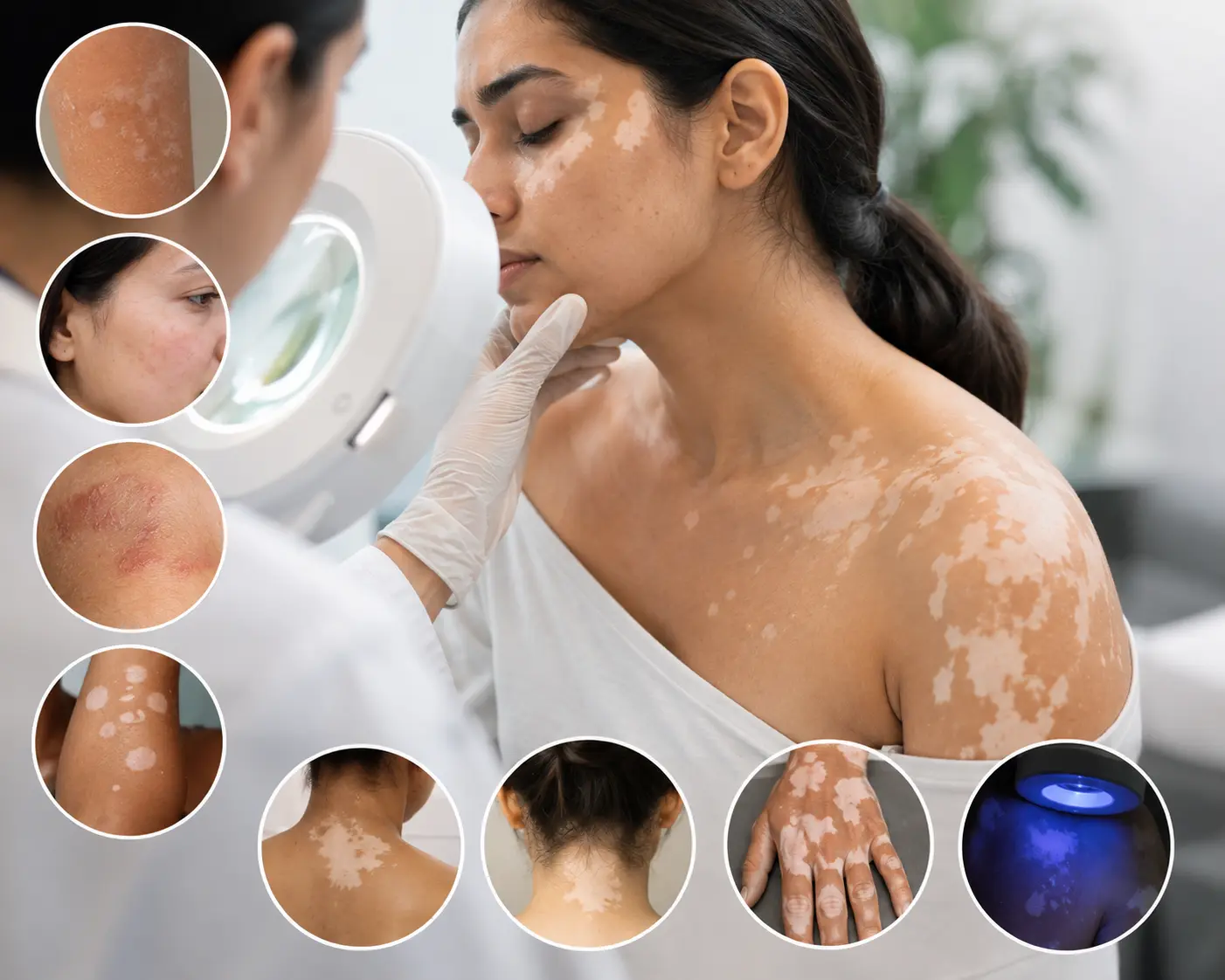
Vitiligo is an autoimmune condition in which the immune system attacks melanocytes — the cells responsible for producing skin pigment. This results in smooth, well-defined white patches that can appear anywhere on the body, including the face, hands, feet, and around body openings like the eyes and mouth. Vitiligo patches:
– Are usually *completely depigmented* (milky white, not just lighter)
– Have *sharp, well-defined borders*
– Often appear *symmetrically* on both sides of the body
– Are *not scaly, itchy, or raised* in most cases
– Tend to *spread gradually over time*
## Conditions Often Confused With Vitiligo
### 1. Tinea Versicolor (Fungal Infection)
This common fungal skin condition causes light or dark patches, often on the chest, back, or shoulders. Unlike vitiligo, tinea versicolor patches:
– Usually have a *fine scale* when scratched
– May be *slightly itchy*
– Tend to appear in *oily-skin areas* like the upper trunk
– Respond to *antifungal treatment*, not immune-based therapy
### 2. Pityriasis Alba
Common in children and young adults, this condition causes faint, slightly scaly, light patches — usually on the face. Unlike vitiligo, the patches are:
– *Not fully white*, just lighter than the surrounding skin
– *Mildly scaly*
– Often linked to *dry skin or mild eczema*
– Usually *fade on their own* over months
### 3. Post-Inflammatory Hypopigmentation
After an injury, burn, acne, or skin infection heals, the skin in that area can temporarily lose pigment. This differs from vitiligo because:
– It has a *clear history of prior skin trauma or inflammation*
– The lightened area is *not usually milky white*
– Pigment often *returns gradually* without specific treatment
### 4. Idiopathic Guttate Hypomelanosis
Small, scattered white spots — often on the shins and forearms — that become more common with age and sun exposure. These differ from vitiligo because they:
– Are usually *small (a few millimeters)* rather than large patches
– Don’t tend to *spread or merge* the way vitiligo can
– Are considered a *normal age-related skin change* rather than an autoimmune condition
### 5. Leprosy-Related Skin Patches
In some regions, pale patches from leprosy are mistaken for vitiligo, and vice versa — leading to significant anxiety. The key differences:
– Leprosy patches often show *loss of sensation* (numbness) in the affected area
– Vitiligo patches retain *normal sensation and skin texture*
– Leprosy requires a completely different diagnostic and treatment pathway
## Why an Accurate Diagnosis Matters So Much
Treating the wrong condition doesn’t just waste time — it can allow the actual underlying issue to progress. A fungal infection treated as vitiligo won’t clear up. Vitiligo treated with antifungal cream won’t respond either. This is why dermatologists typically use tools like a Wood’s lamp examination, sometimes alongside a skin scraping or biopsy, to confirm exactly what’s causing the pigment change before recommending a treatment plan.
This diagnostic step is a core part of what makes a dermatology clinic worth trusting — and it’s a key reason patients actively look for the *best vitiligo treatment in Malappuram* rather than attempting home remedies based on appearance alone.
## How Neoskin Speciality Centre Approaches Diagnosis
At Neoskin Speciality Centre, every patient presenting with light or white patches goes through a proper clinical evaluation — not an assumption based on how the patch looks to the naked eye. This typically includes:
1. *Detailed history-taking* — when the patch appeared, whether it’s spreading, family history of vitiligo or autoimmune conditions
2. *Wood’s lamp examination* — helps distinguish vitiligo’s fluorescence pattern from other pigment conditions
3. *Physical examination* — checking texture, sensation, scaling, and symmetry
4. *Additional tests if needed* — to rule out fungal, autoimmune, or other causes
Only after this process does the clinic recommend a treatment path — whether that’s topical therapy, phototherapy, or other options suited to the specific diagnosis and the extent of pigment loss.
## Finding the Right Care Path
Once vitiligo is confirmed, treatment options can range from topical corticosteroids and calcineurin inhibitors to phototherapy and, in some cases, surgical approaches — depending on how much skin is affected and how the condition is progressing. This is where it becomes important to consult a clinic experienced specifically in pigment disorders. Searching for the *best vitiligo treatment in Malappuram* is a reasonable first step, but the real value comes from finding a team that pairs an accurate diagnosis with a treatment plan tailored to your specific case, rather than a generic protocol.
## When to See a Dermatologist
You should get a professional opinion if you notice:
– A white or light patch that’s *spreading or changing shape*
– Patches with *sharp, distinct borders*
– Loss of pigment *without any prior injury or rash* in that spot
– Any patch accompanied by *numbness or reduced sensation*
– Family history of vitiligo or other autoimmune conditions
## Don’t Guess — Get It Checked
Skin conditions that affect pigmentation can look deceptively similar, but they require very different treatment approaches. Rather than assuming the worst — or dismissing a patch as harmless — a short consultation can give you clarity and a proper plan forward.
For anyone in Malappuram district searching for the *best vitiligo treatment in Malappuram*, Neoskin Speciality Centre offers thorough diagnostic evaluation and personalized treatment plans, so you’re not treating a guess — you’re treating a confirmed diagnosis.
*Neoskin Speciality Centre*
Royal Plaza, Opposite KSRTC, Mannarkkad Road, Perinthalmanna, Malappuram – 679322, Kerala
Contact: +91 88913 54555
—
This article is intended for general informational purposes and is not a substitute for professional medical advice. Please consult a qualified dermatologist at Neoskin Speciality Centre for an accurate diagnosis and treatment plan.